
By Saira, Founder of Marketing by Saira | Digital marketer working with e-commerce and local businesses in Singapore and the UK | Last updated: October 2026
One of the first questions I ask a new client is, ‘What ROAS do you need to make a profit?’ Most do not know. Without that number, every optimisation is a shot in the dark. This guide walks through the exact steps I use to improve Meta Ads ROAS, in the order that gives the fastest results.
Quick answer: To improve Meta Ads ROAS, first calculate your break-even ROAS, then fix your tracking, test new creatives, simplify your campaign structure, use retargeting, improve your landing page and offer, and scale gradually. Creative quality and conversion rate usually have the biggest impact on ROAS.
What Is ROAS in Meta Ads?
ROAS stands for Return on Ad Spend. It measures how much revenue you earn for every dollar spent on ads.
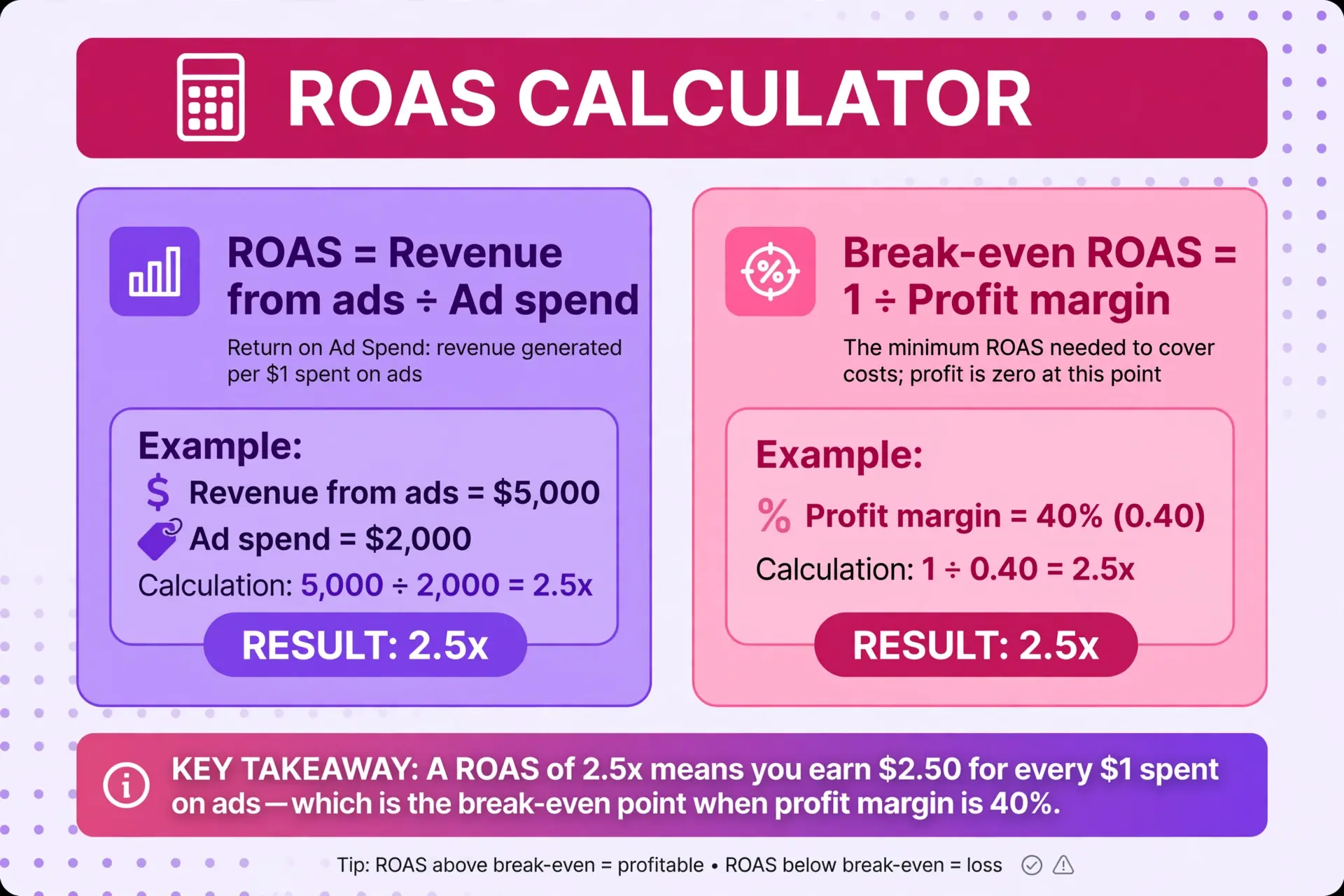
Formula: ROAS = Revenue from ads ÷ Ad spend
For example, if you spend $1,000 on Meta Ads and generate $4,000 in sales, your ROAS is 4.0, often written as 4x or 400%.
In this guide:
- Calculate your break-even ROAS
- Fix your tracking
- Choose the right campaign objective and structure
- Test creatives consistently
- Refine your audience approach
- Use retargeting
- Improve your landing page and offer
- Scale without breaking performance
If your campaigns are leaking budget on basic setup errors, read our guide on 7 Meta Ads Mistakes first.
What Is a Good ROAS for Meta Ads?
A good ROAS is any number above your break-even ROAS. There is no universal benchmark, because margins differ by business. Many e-commerce brands aim for 3x to 4x, but a business with high margins can be profitable at 2x, while a low-margin store may need 5x or more.
Step 1: How Do You Calculate Your Break-Even ROAS?
Break-even ROAS is the minimum return you need to avoid losing money on ads.
Formula: Break-even ROAS = 1 ÷ Profit margin
If your profit margin is 40%, your break-even ROAS is 1 ÷ 0.40 = 2.5. Any result above 2.5 is profit, and anything below it is a loss.
Why it matters: Many advertisers chase a high ROAS without knowing their target. Set this number first and judge every campaign against it. Knowing this number is the starting point of any serious plan to improve Meta Ads ROAS.
Step 2: Why Does Tracking Affect ROAS?
Meta optimises towards the conversions it can see. If your Meta Pixel and Conversions API are missing events or sending duplicates, the algorithm learns from bad data and your reported ROAS becomes unreliable.
The fix:
- Install the Meta Pixel and set up the Conversions API
- Test Purchase, Add to Cart and Initiate Checkout events
- Pass accurate purchase values so Meta can optimise for revenue
- Compare Ads Manager numbers with your actual store or CRM sales
Step 3: Which Campaign Objective and Structure Improve ROAS?
For e-commerce, use a Sales (Purchase) objective. For local businesses, use Leads or Messages, depending on how you close customers. Keep your structure simple, because too many small campaigns split your budget and slow down learning.
The fix:
- One campaign per goal
- Fewer ad sets with more budget each
- Aim for around 50 optimisation events per week per ad set so Meta can exit the learning phase
- Test Advantage+ sales campaigns (formerly Advantage+ Shopping) alongside your manual campaigns and compare results
Step 4: How Do Creatives Improve Meta Ads ROAS?
Creative is the biggest lever you control. Meta’s targeting is largely automated now, so your ad itself does most of the audience selection. Consistent creative testing is the most reliable way to improve Meta Ads ROAS month after month.
The fix:
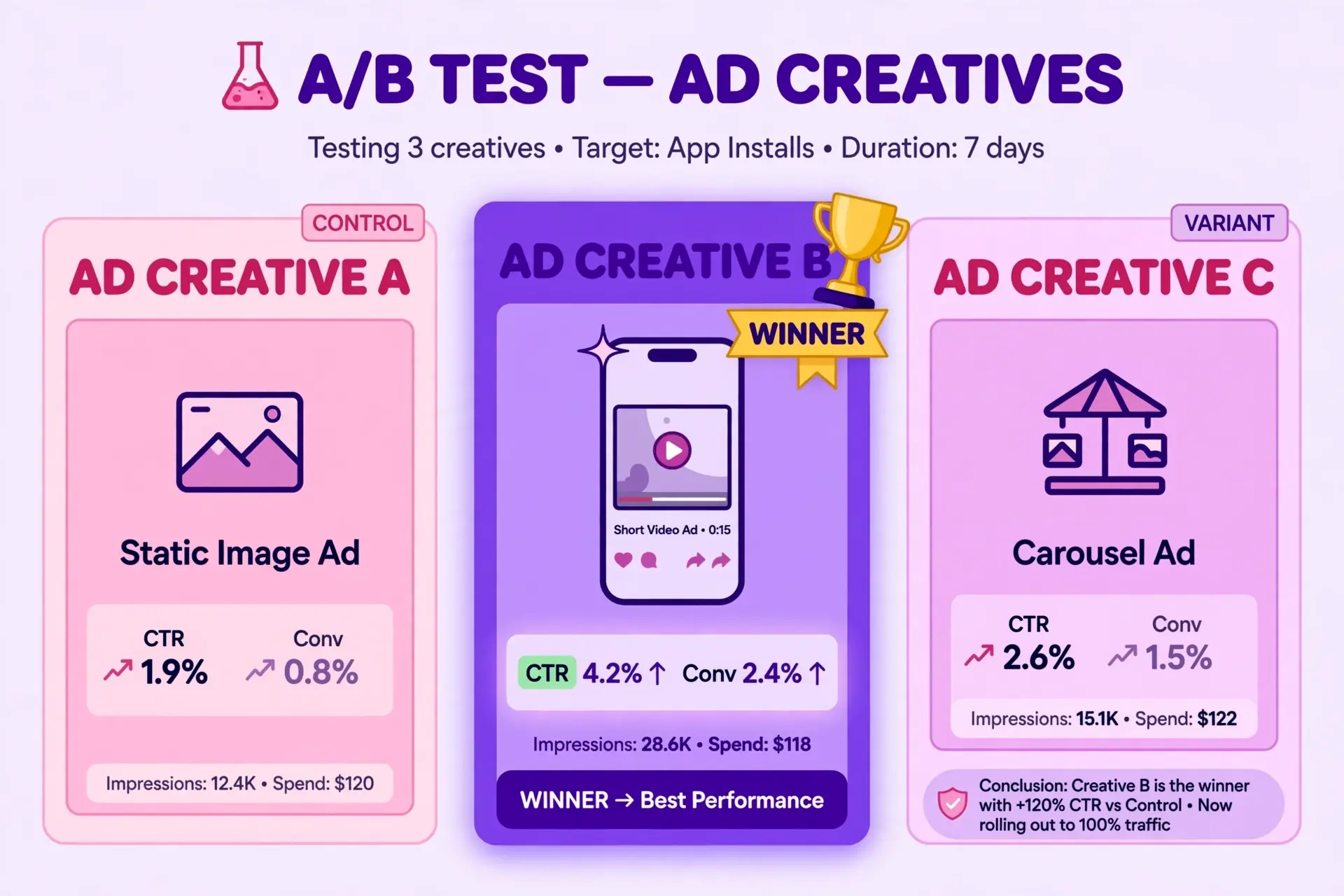
- Test 3 to 5 new creatives at a time, with different hooks and angles
- Use short videos with a strong first three seconds
- Show real people, real results and real customer reviews
- Put the offer and benefit clearly in the first line of copy
- Replace creatives when frequency rises and click-through rate falls
Step 5: Which Audience Targeting Works Best for ROAS?
There is no single winning audience, so test instead of assuming. Start with broad targeting for e-commerce, then compare it with interest-based and lookalike audiences. For local businesses, use a tight location radius around your service area.
The fix: Exclude existing customers from acquisition campaigns, and exclude recent purchasers from retargeting, so you do not waste spend on people who have already bought.
Step 6: Does Retargeting Increase ROAS?
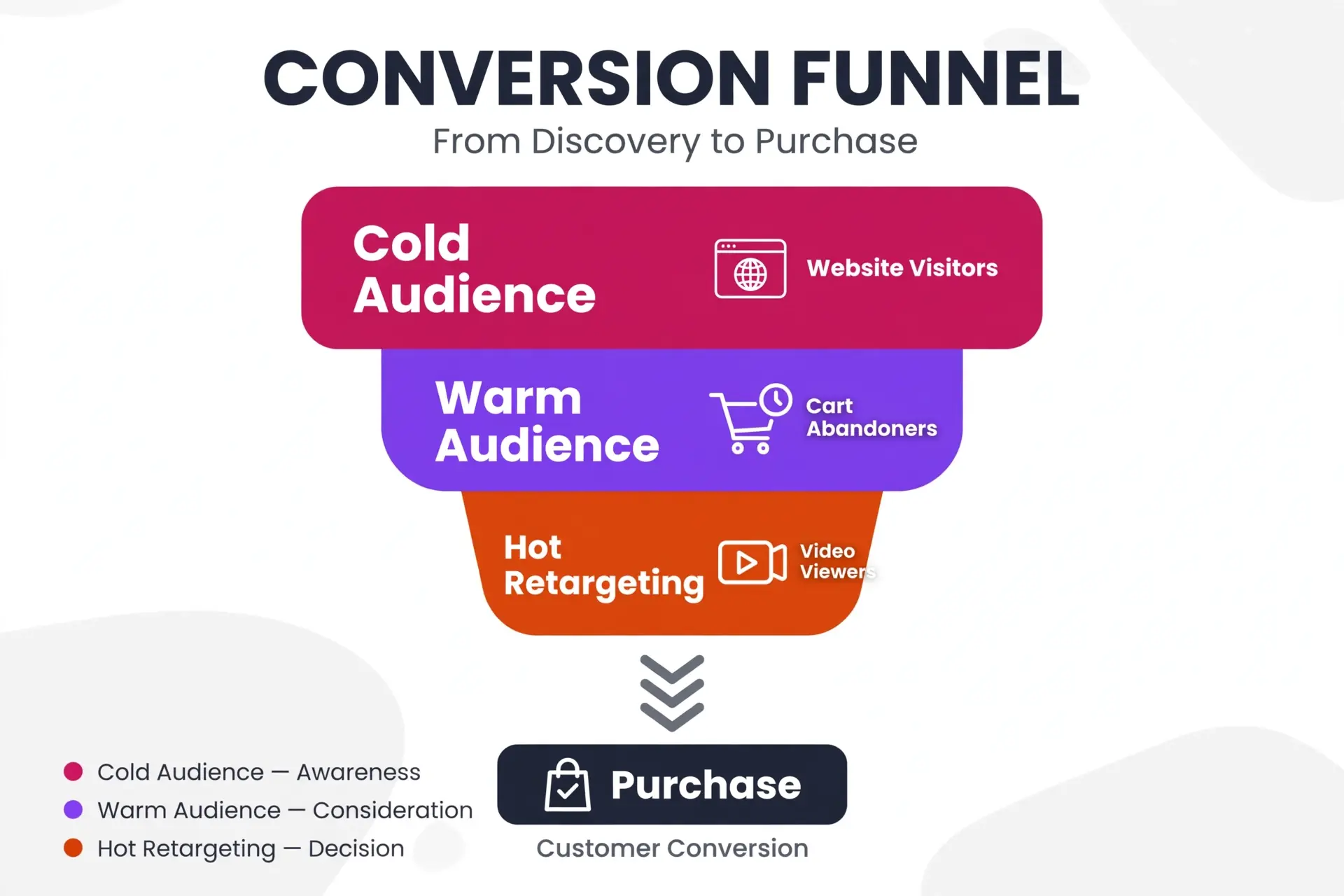
Yes. Warm audiences usually convert at a lower cost than cold ones, which lifts your overall ROAS.
The fix: Build audiences from website visitors, product viewers, cart abandoners and video viewers. Show them testimonials, reviews, product benefits or a limited-time offer. Keep retargeting windows sensible, for example 7, 14 and 30 days.
Step 7: How Do Landing Pages and Offers Affect ROAS?
ROAS is not only about ads. If 100 people click and only 1 buys, no amount of ad tweaking will fix a weak page or offer. A strong offer and a fast page can improve Meta Ads ROAS more than any targeting tweak.
The fix:
- Make sure the page loads fast on mobile
- Match the headline and image to the ad
- Add reviews, delivery details and clear return policies
- Test offers such as bundles, free shipping thresholds or first-order incentives
- Try increasing your average order value with upsells and bundles, since higher order value raises ROAS without raising ad spend
Step 8: How Do You Scale Meta Ads Without Hurting ROAS?
Scaling too fast is a common reason ROAS collapses. Big budget jumps can disturb delivery and push you back into learning. Slow, steady scaling is how you improve Meta Ads ROAS without breaking what already works.
The fix: Increase budgets by around 20% every few days on winning ad sets, or duplicate winning ads into new ad sets. Keep a close eye on cost per purchase and frequency as you scale.
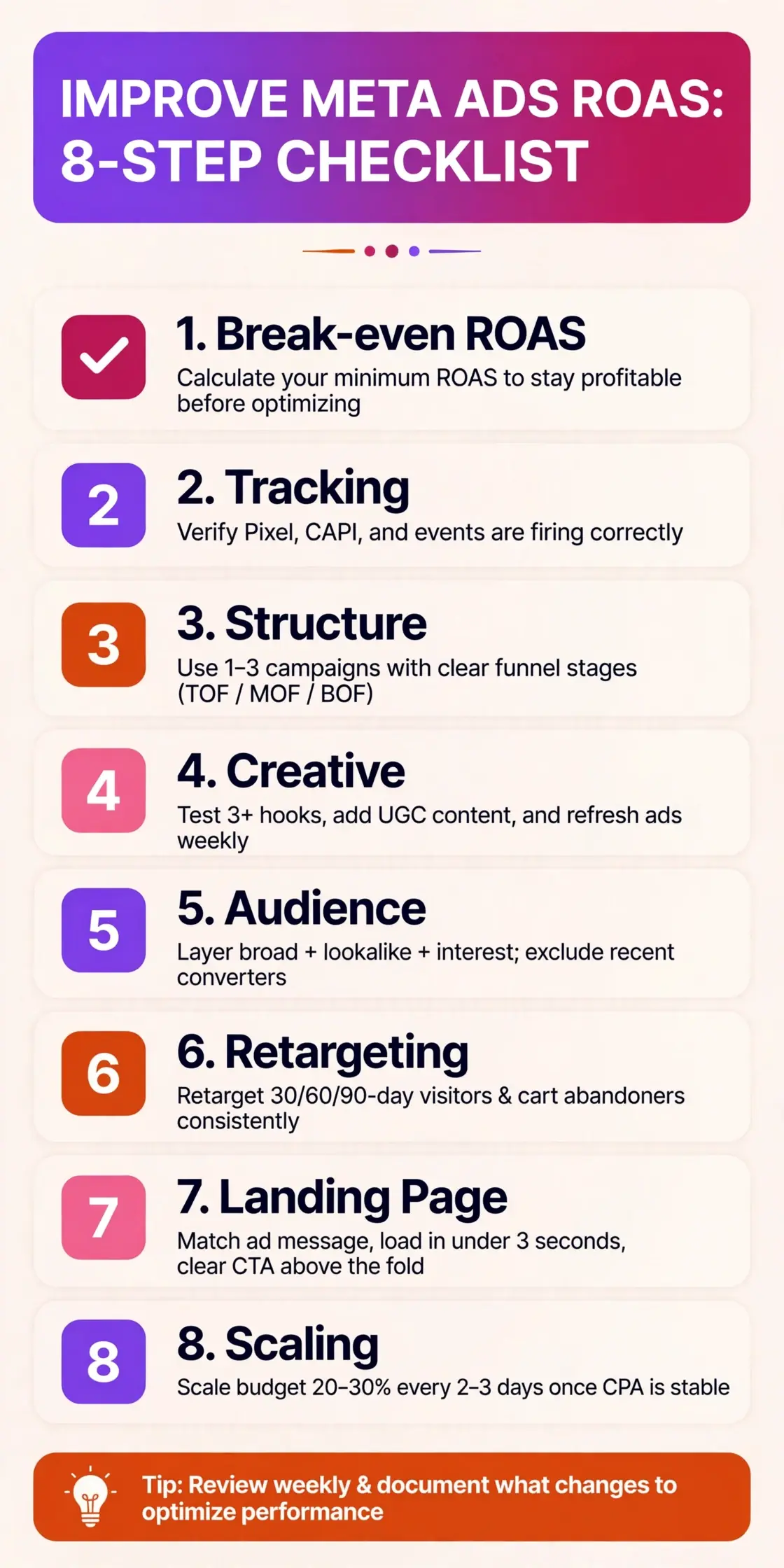
Meta Ads ROAS Improvement Checklist
| Step | Action |
|---|---|
| Target | Break-even ROAS calculated |
| Tracking | Pixel and Conversions API tested |
| Structure | Simple campaigns, enough budget per ad set |
| Creative | New tests every 2 to 3 weeks |
| Audience | Broad, interest and lookalike tested |
| Retargeting | Warm audience campaign live |
| Landing page | Fast, clear, mobile-friendly |
| Scaling | Gradual budget increases |
Frequently Asked Questions
What is a good ROAS for Meta Ads?
A good ROAS is one above your break-even point. Many e-commerce brands aim for 3x to 4x, but the right number depends on your profit margin.
Why is my Meta Ads ROAS low?
Common causes include weak creatives, poor tracking, a low-converting landing page, wrong objective selection and audience overlap. Start by checking tracking and creatives.
How long does it take to improve ROAS?
Small improvements can show within one to two weeks, but meaningful results usually need three to four weeks of consistent testing.
Is ROAS the same as profit?
No. ROAS measures revenue against ad spend only. It does not include product cost, shipping, fees or other expenses, which is why break-even ROAS matters.
Does a higher budget lower ROAS?
Not always, but it can if you scale too quickly or run out of strong creatives and audiences. Scale gradually and keep refreshing your ads.
Final Thoughts
Improving Meta Ads ROAS is a process of knowing your numbers, fixing your foundations, testing creatives and scaling carefully. Start with break-even ROAS and tracking, then work through the steps in order. Follow these steps and you will steadily improve Meta Ads ROAS over time.
Want a second pair of eyes on your account? Marketing by Saira offers Meta Ads management, Google Ads, SEO and content strategy for e-commerce and local businesses in Singapore and the UK. Get in touch for a review of your Meta Ads setup and a clear action plan.